You want the calm appearance of concrete but are unsure between large concrete tiles and a concrete floor poured on site. In photos, these solutions can look very similar. However, the build-up, joints, installation and possibilities during renovation do differ.
At Glansbeton we start from the intended use of the space and the available floor construction. Below you will read what is meant by polished concrete tiles, how to compare them with a poured floor and which points to discuss with the contractor beforehand. The examples on this page are our own executed concrete floors.
This can also be done with a poured concrete floor in which a pattern is cut. See the residential concrete floor in tile pattern in Herk-de-Stad. This is a different execution than laying separate prefabricated tiles.
What are polished concrete tiles?
Concrete tiles are individual elements manufactured in a factory or workshop and then installed on site. Their appearance depends on the composition, colour, surface finish and any protection applied. The term “polished” does not mean exactly the same to every supplier. Always ask for a sample and the technical datasheet of the specific concrete tile.
A tile with a smooth finished surface is not automatically suitable for every application. A living space, outdoor terrace and drivable driveway each have different requirements. The size alone also does not indicate how much a tile can bear. The combination of product, thickness, substrate and installation method must be suitable for the intended use.
Burnishing, polishing and a tile pattern: what is the difference?
| Execution | What happens? | What do you see? |
|---|---|---|
| Prefabricated concrete tiles | Individual elements are placed on a suitable substructure. | A floor with joints between the tiles. |
| On-site polished concrete | Fresh power-trowelled concrete is finished at the right moment with a power trowel or, where necessary, by hand. | A coherent floor slab with the necessary joints and the natural character of concrete. |
| A sawed tile pattern | In a poured floor, a pre-agreed pattern is cut. | Large surfaces with the appearance of tiles, while the base remains a poured floor. |
| Polished afterwards concrete | Hardened concrete is mechanically ground and further finished. | A different surface appearance, possibly with more visible aggregates, depending on the treatment. |
These terms are often used interchangeably. When making an enquiry, feel free to show a photo of the result you are looking for. Then we can discuss which execution suits that, without you needing to know all the technical terms yourself.
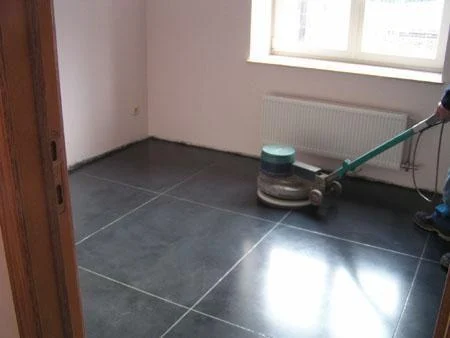
Which solution suits your home?
In new construction, there is often still room to determine the floor build-up, insulation, pipes and finished height together. This makes it possible to include a poured concrete floor in the design from the start. In an existing home, it must first be clear how much build-up height is available and what the substrate can support.
Loose tiles can be interesting when their size, build-up and laying method fit the renovation. A poured floor is interesting when you seek a continuous concrete appearance. Neither is automatically the best choice for every home. Doorsteps, doors, stairs and connections to other floors also determine what is practically feasible.
The thickness of a new concrete floor is determined per project. A thin decorative layer, ceramic tile with a concrete look and solid concrete floor are different products. Therefore, compare them based on their full construction and use, not just on a photo or price per square metre.
Is it also possible on a terrace or driveway?
Outside, drainage, rain, frost, dirt and grip are important considerations. A smooth surface can become more slippery when wet. For a prefab tile, explicitly check if it is suitable for the intended outdoor application. For a driveway, traffic load and the supporting structure must also be taken into account.
For poured concrete, we discuss the finishing together with the slopes and water drainage. Those seeking visible stones and more surface relief can also exposed aggregate concrete see. That has a different appearance than a fresh power-trowelled concrete floor.
Do you want separate large areas in the garden? In our article about concrete stepping stones you see a concrete execution. The large sawn surfaces of a terrace in Diepenbeek show a different design. Both examples help to make the desired design discussable.
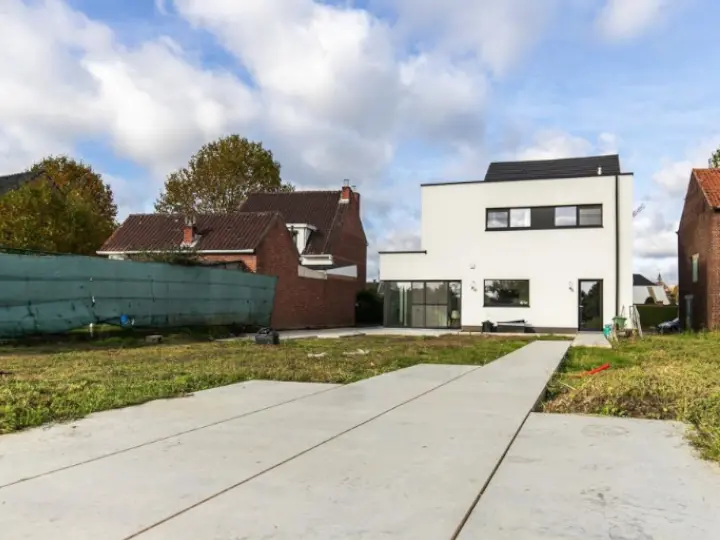
Choosing colour, gloss and size
Grey concrete exists in many shades. Colour additives, the chosen wear layer, the polishing work and further protection also influence the final appearance. A photo on a screen is therefore not a reliable colour sample. Where possible, view a real sample or a similarly finished floor.
For prefab tiles, dimensional tolerances and differences between production batches also play a role. Poured concrete naturally shows colour nuances and traces of the execution in the material. Discuss beforehand how much pattern you find attractive. Anyone expecting a completely uniform, identical surface everywhere must explicitly state this before a floor is chosen.
Large surfaces provide a calm appearance, but the pattern must suit the space. Align the lines with walls, passages and fixed elements. A decorative saw pattern does not automatically replace the technically necessary joint plan.
Joints, cracks and underfloor heating
Concrete shrinks during curing and moves under the influence of temperature. Therefore, both a floor construction with tiles and a poured concrete floor require attention to joints and connections. Existing movement joints cannot simply be concealed. No installation can be guaranteed to be completely crack-free without reservation.
Underfloor heating requires coordination between design, installation and commissioning. The necessary build-up, pipe layout and heating procedure depend on the chosen system. Also read our explanation about a concrete floor with underfloor heating. Have those agreements recorded before the work starts; adjusting afterwards is usually much more difficult.
Maintenance and protection
A smooth floor remains most beautiful with maintenance suited to the surface. Remove sand and other abrasive dirt regularly. Use a suitable cleaning agent and the prescribed dosage. More product does not automatically mean a cleaner floor: residues left behind can make the surface dull or streaky.
Acids and aggressive cleaners can damage cement-bound surfaces. Also, oil, wine and other spilled liquids are best removed promptly. A protective product can support maintenance, but does not make a floor invulnerable or guaranteed stain-free.
For tiles, follow the manufacturer's instructions for both the tile surface and the joints. For our concrete floors, read more at polishing a concrete floor, impregnating a concrete floor and concrete hardener for residential floors. These are different treatments each with their own purpose.
What determines the price?
Comparing the price of a single tile with the price of a fully executed concrete floor does not give a fair picture. Include the same components in both quotes: preparation, substrate, materials, delivery, installation, joints, protection and finishing at the edges.
For a poured floor, surface area, accessibility, corners, level differences and the chosen finish affect the execution. For large prefab tiles, transport, handling, cutting and installation tools can have a significant impact. Also, removing an existing floor and adjusting connections can form an important part of the budget.
You should not infer a longer lifespan or lower maintenance cost solely from the name of the material. Ask which tasks and products are involved in regular maintenance and what repair entails in case of local damage. This way, you compare the solutions based on their actual use.
What do you provide for targeted advice?
- The application: for example kitchen, living room, terrace or driveway.
- The surface area and a plan with dimensions.
- Photos of the existing condition and access to the site.
- The available floor height and what is already known about the substrate.
- Information about underfloor heating, drainage and any cracks.
- An example of the colour, pattern or appearance you are looking for.
With that information, we can assess whether a poured concrete floor suits the project and what preparation is needed. You do not yet need to have chosen the technical solution yourself.
Large surfaces or a calm residential concrete floor?
See our residential concrete floors and the executed examples. If you want to know what suits your home, please send us your plan and some photos.
Discuss your concrete floorMore background on prefab paving can be found at FEBE – concrete tiles and concrete slabs. The technical datasheet of the chosen product remains decisive for the application.
Polished concrete tiles or a poured concrete floor?