Concrete knowledge · fibres and floor construction
Glass fibre reinforced concrete contains glass fibres that are distributed through the concrete mixture. Depending on the product and application, they help to control cracking or contribute to the material's performance. The right choice starts with the question of what those fibres need to do in your floor.
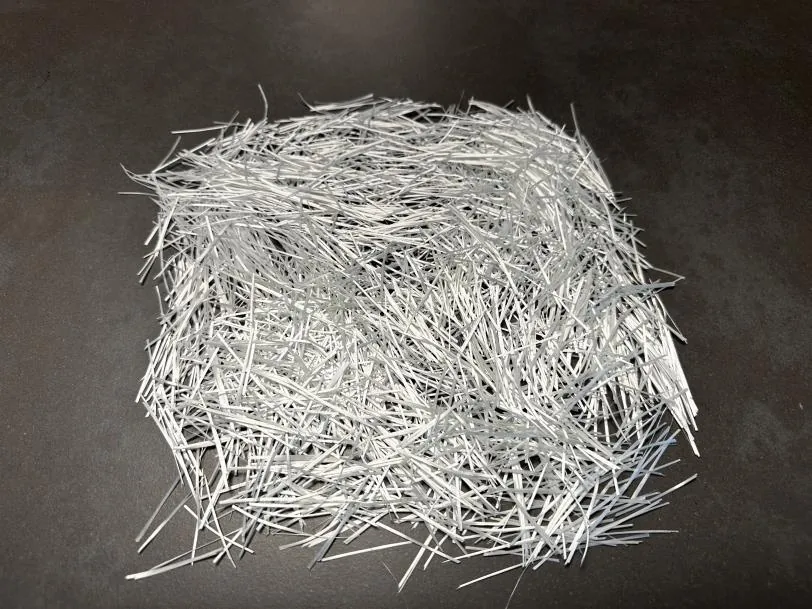
What is fibre-reinforced concrete?
In fibre concrete, short fibres are added to a cement-bound mixture. They are distributed throughout the volume, unlike a reinforcement mesh which lies at a certain height in the floor. The performance they provide depends, among other things, on fibre length, shape, composition, dosage and adhesion to the concrete.
For cement-bound applications, the suitability of the glass fibre is important. The environment in concrete is alkaline. Therefore, specially developed alkali-resistant glass fibres exist, often referred to as AR glass fibres. An arbitrary glass fibre for another industry is not automatically suitable for mixing into a concrete floor.
The term glass fibre concrete is also used for different products. A thin façade element in glass fibre reinforced mortar is different from an in-situ cast, power-trowelled floor. Properties and dosages of those applications cannot simply be interchanged.
Can glass fibres replace a reinforcement mesh?
This cannot be decided based on the word glass fibre alone. Some fibres are used to control early shrinkage cracks; other systems have a different or more extensive function. A structural replacement of reinforcement requires a substantiated design and suitable product data.
Shrinkage control is not the same as load-bearing capacity.
A fibre that helps with plastic shrinkage does not automatically make a reinforcement mesh redundant. The designer must determine which reinforcement is necessary for the load, floor construction and project details.
Local reinforcement at edges, openings or other critical zones may still be necessary. The presence of fibres does not automatically change the required floor thickness, substrate load-bearing capacity or joint layout.
How much glass fibre should be in concrete?
There is no universal dosage that applies to all glass fibres and concrete floors. Start from the technical datasheet of the specific product and the application for which it is prescribed. The required amount can vary greatly between a fibre for early shrinkage control and another reinforcement system.
When placing an order, fibre type, quantity, mixing procedure and concrete volume must be clearly specified. An indication in kilograms per cubic metre differs from a percentage of the cement mass or the total concrete weight. These different units must not be used interchangeably.
Adding more fibres is not automatically better. An unsuitable amount or poor mixing can complicate processing. Have the batching plant and the contractor coordinate in advance how the fibres will be evenly distributed in the mix.
Glass fibres, steel fibres or synthetic fibres?
| Material | What to watch out for? |
|---|---|
| Glass fibres | Choose a fibre suitable for cementitious material and the intended function. Glass does not rust like steel, but product choice and design remain decisive. |
| Steel fibres | Another reinforcement system with its own product and design requirements. The influence on the visible finish must also be discussed. |
| Plastic fibres | Distinguish between microfibres and macrofibres. There are also plastic macrofibres for structural applications. |
The choice therefore does not follow from a simple ranking where one material is always better. Look at the demonstrable performance of the system in the complete concrete floor.
Can glass fibre concrete be polished?
A suitable combination of concrete mix and fibres can be executed with a power-trowelled finish. The finish does require attention to workability, fibre distribution and the correct timing of power-trowelling. The fibres do not make an unsuitable mix into a good residential floor.
For residential concrete appearance also matters. Therefore, discuss in advance the colour, possible visibility of fibres and the intended surface treatment. In our project in Glabbeek a floor with fibre reinforcement is discussed, along with the subsequent protective treatment.
What remains important during execution?
A suitable substrate, correct levels, sufficient thickness and a well-considered joint layout remain fundamental. Fibres are one component of that structure. They do not prevent a floor from moving or being damaged due to an unsuitable foundation or other design flaw.
After finishing, the fresh concrete must be protected against too rapid drying. Therefore, also read our explanation about concrete curing. If you want to know what a concrete class such as C30/37 means, then see compressive strength of concrete. A fibre addition and a compressive strength class describe different properties.
Frequently asked questions
Is a concrete floor with glass fibres crack-free?
No. Suitable fibres can contribute to crack control, but do not prevent cracks. Substrate, design, execution, joints and concrete curing remain important.
Can glass fibre concrete be placed using a concrete pump?
This depends on the mixture, fibre type, dosage and pumping system. Coordinate pumpability with the supplier; do not assume it automatically for every combination.
Is glass fibre always cheaper than a reinforcement mesh?
Compare the complete execution: material, calculation, placement, logistics and any additional reinforcement. Only the purchase price of fibres or nets does not provide a fair comparison.
Technical background: Cem-FIL and Anti-CRAK glass fibre products from Owens Corning and an example of structural synthetic macrofibres from Sika. The product datasheet and the project design determine the application.
Glass Fibre Reinforced Concrete: Application, Reinforcement and Polishing