A polished concrete floor is often chosen for its strong, seamless, and industrial appearance. Nevertheless, it is important to fully understand beforehand what is technically meant by the flatness of a concrete floor.
Flatness is not about the exact height of the floor relative to a fixed reference level. That is called the floor level. Flatness concerns local irregularities in the floor surface. A concrete floor can therefore be correctly levelled and still have small local deviations in flatness. That is why flatness and level are technically assessed as two separate criteria.
What does flatness mean for a polished concrete floor?
The flatness of a polished concrete floor describes how even the floor surface is over a certain distance.
This does not mean that a polished concrete floor must be completely mirror-flat or absolutely perfectly straight. Concrete is cast, processed and polished on site.
The execution takes place on site and not in a factory under fully controlled conditions. Factors such as the substrate, the composition of the concrete, the timing of the polishing, temperature, humidity and accessibility of the space all influence the final result.
Concrete floor flatness and level: what is the difference?
Flatness and level are often confused with each other.
The level refers to the height of the floor relative to an agreed reference point. Flatness concerns local deviations in the surface itself.
A floor can be within the correct level but still show local unevenness. Conversely, a floor can appear locally flat but not be exactly at the desired level everywhere. Therefore, these two aspects must be assessed separately.
Concrete floor flatness classes according to TVN 267
TVN 267 distinguishes different flatness classes for finished concrete floors.
These classes indicate which deviation is acceptable when checked with a straightedge of 2 metres.
When no specific flatness class is mentioned in the contractual documents, the TVN 267 standard flatness class IV applies.
For residential applications, flatness class II is often referred to as the usual class. A stricter flatness class does require more preparation, control and execution precision. This also affects the cost of the concrete floor.
Why is flatness of a concrete floor important?
The required flatness depends heavily on the intended use of the floor.
In a home, showroom or office space, the focus is mainly on comfort, maintenance and daily use. In warehouses, workshops and industrial buildings, flatness plays an even greater role.
Such a deviation can affect:
- mobile equipment
- forklifts and machinery
- storage racks
- productivity
- safety
- maintenance costs
In high-rack warehouses, even small deviations in the floor can have major consequences at greater heights. Therefore, the floor, storage system and mobile equipment must always be well coordinated.
For homes and private projects, flatness must be considered realistically. A polished concrete floor is not a ceramic tile, natural stone slab, or cast synthetic floor. It is an on-site cast concrete floor with its own technical tolerances.
Interested in a perfectly executed concrete floor?
How is the flatness of a concrete floor checked?
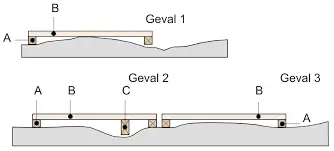
The flatness of a concrete floor is not correctly assessed by simply placing a straightedge on the floor and visually checking where light passes underneath.
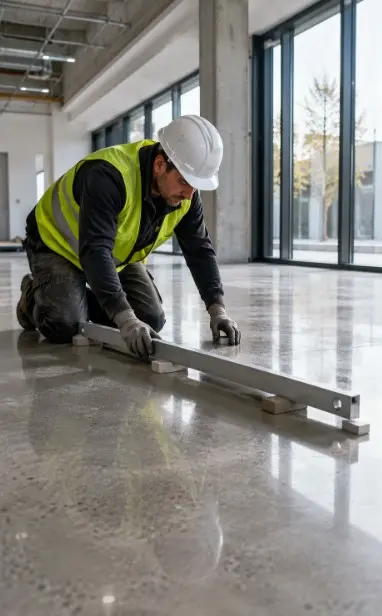
A correct inspection is carried out according to a clear method using a straightedge of 2 metres and control blocks that correspond to the permitted deviation.
Consideration is given to:
- the prescribed flatness class
- the correct measurement method
- the location of the control points
- the difference between general and local flatness
- the intended application of the floor
A few local measurements are insufficient to technically reject an entire concrete floor. Local flatness and overall flatness must be correctly distinguished from each other.
Discussing the flatness of polished concrete correctly before execution
A correct expectation starts before the placement of the concrete floor.
The desired flatness must be adapted to the use of the space. Different requirements may apply for a garage, house, showroom, warehouse or workshop.
At Glansbeton we discuss these technical properties as clearly as possible in advance. This way, you know which tolerances are realistic and what you can expect from a polished concrete floor. Good preparation prevents misunderstandings afterwards.
Flatness of polished concrete floors