Curing for concrete protects freshly poured concrete against too rapid moisture loss, allowing the cement to continue hardening. For industrial floors and basement floors, this is a fundamental step for a strong, wear-resistant top layer. After polishing, the floor is not yet fully cured. We adapt the method to the use and desired appearance; for residential concrete, we prefer our concrete densifier.
Why is concrete curing important?
A concrete floor can already appear nicely smooth while the cement is still hardening intensively. For that reaction with water, the hydration, sufficient moisture must remain available. If the top dries out too quickly, the very layer on which you later walk or drive will experience less favourable curing conditions.
Curing protects the young concrete during that vulnerable phase. It is part of good workmanship, even when the polishing is already finished. Buildwise emphasises in TV 267 that curing is essential for the quality of concrete floors, especially for the surface layer.
A better top layer
Retaining moisture helps the cement at the surface to continue hydrating. This supports the development of surface strength. Simply power-trowelling does not replace this protection.
Resistance to wear
In an industrial floor, the top layer bears the traffic and operational load. The efficiency of the concrete curing is one of the factors that determine wear resistance, alongside composition, wear layer and execution.
Limiting shrinkage damage
Rapid evaporation can cause shrinkage stresses at a time when the concrete has little tensile strength. Timely protection helps limit cracking caused by plastic shrinkage and drying shrinkage. Joints, reinforcement and floor design also remain important.
Durable surface quality
A sufficiently hardened top layer is important for later use and maintenance. A nice appearance on the day of pouring does not tell everything about how the surface will behave under load.
That is why we consider curing before pouring. For large floors, protection and finishing must align per zone. A product that still needs to be sourced when the power trowel leaves is too late in the schedule.
Technical basics: Buildwise TV 267, § 6.5: curing of concrete floors, supplemented with chapters on wear resistance, dust emission and shrinkage.
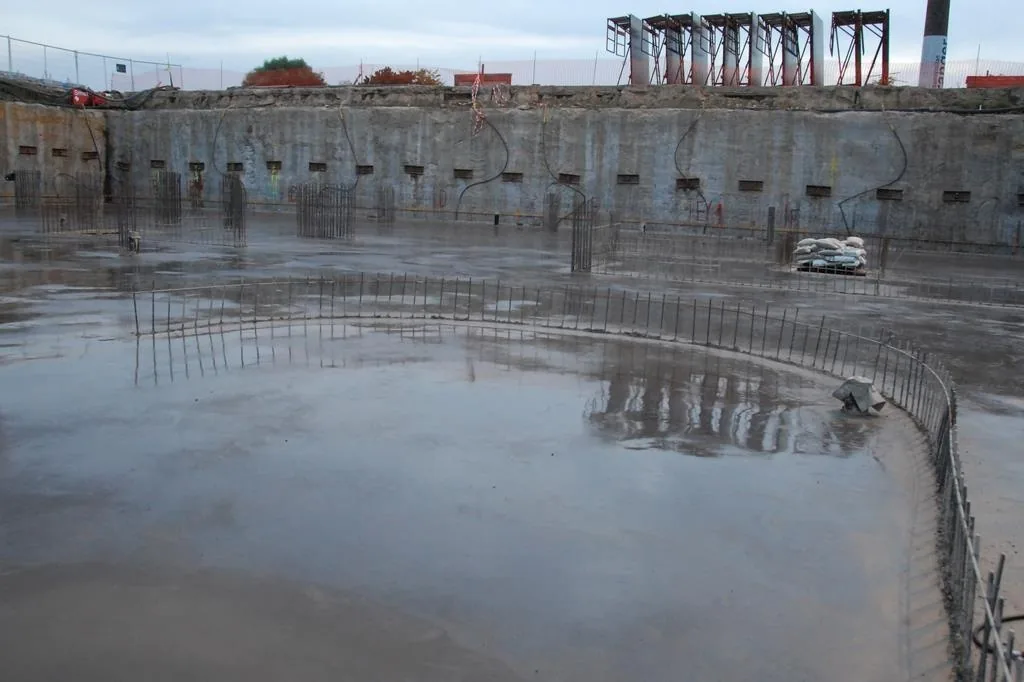
How is the cure performed?
There are various methods, such as suitable covering, keeping moist or applying a curing compound. The latter forms a temporary barrier against evaporation. Which method is appropriate depends, among other things, on the surface, conditions and further finishing.
For a visible floor, the appearance also matters. That is why we coordinate the working method in advance and indicate to the client what they may and may not do with the floor after execution.
Curing for your industrial floor
In our shop you will find curing compound for the curing of fresh power-trowelled concrete. Check the product information and tailor the application to the floor and further finishing.
View curing compound in the shopWhen should curing begin?
As soon as possible after surface finishing, using a method suitable for the concrete and the conditions. For polished concrete floors, the final protection can usually only be applied after finishing. The period before that therefore also requires attention: sun and drafts can already dry out the fresh surface while the crew waits for the right finishing moment.
According to TV 267, early shrinkage cracks during finishing can be partially concealed, but they remain vulnerable spots for later cracking. Therefore, waiting until the next morning to discuss the concrete curing is not a good approach.
A basement or indoor space is not automatically free from drying-out risk. Openings, air flow, temperature and humidity all play a role. In cold weather, protection against freezing must also be taken into account. See the basement projects by Glansbeton for examples of this type of concrete floors.
How long does curing take?
A fixed number of days for all concrete floors is not a good starting point. The concrete composition, temperature and required performance influence the duration. Follow the project agreements and the specifications of the product used. Walkability also does not mean that the floor is ready for every load or treatment.
TV 267 determines the required duration based on the strength development of the concrete, the temperature at the concrete surface and the environmental conditions. Strong wind, sun or dry air can form an unfavourable combination. A general statement such as “after one day every floor is sufficiently cured” does not do justice to this.
The duration of the necessary protection is moreover not the same as the time during which a curing film can still be seen. The film may remain visible for longer and only gradually wear away. This in itself does not indicate when the floor may be subjected to vehicle loads or further finished.
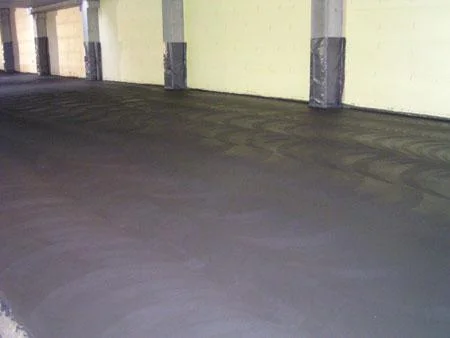
Curing is not the same as floor protection against stains
Curing limits early moisture loss. A later treatment against dirt, moisture or stains serves a different purpose. Impregnation means that a product penetrates into the substrate; its function depends on that product. A concrete densifier works differently than a film-forming curing compound. Moreover, a remaining curing film can affect the adhesion of a subsequent coating. Check the substrate and product instructions before applying a next finish.
Does curing wear off and can it leave stains?
The film of a curing compound does not remain present everywhere for the same length of time. With intensive foot traffic, driving and cleaning, it gradually wears away. Less loaded areas can retain the layer longer, causing the surface to temporarily appear uneven.
A curing layer can cause marks, differences in gloss or staining. These may gently diminish in the months following application, but can also remain visible. Therefore, we do not promise that every mark will disappear on its own or within a fixed period. The assessment for an industrial floor is made differently than for a visible floor in a residence.
Industrial floor or functional basement floor
For us, curing compound is a basic treatment for industrial floors. The primary task is to limit moisture loss in the fresh concrete. Also discuss in advance the expected use, desired appearance and any subsequent coatings.
View our basement projects →Residential concrete: our preference for concrete hardener
For residential concrete, at Glansbeton we prefer our concrete densifier. It hardens and densifies the top layer and is applied immediately after power-trowelling within our method, with a curing effect.
This way we avoid the temporary resin film and the associated marks of a classic curing compound. The chosen treatment must suit the concrete composition and the execution; not every concrete hardener works the same way.
Read how our concrete hardener works →Pouring concrete in hot weather: preparation and concrete curing
A warm pouring day requires more preparation than just starting earlier. The delivery, placing, power-trowelling and protection of the fresh floor must be coordinated. Discuss the weather forecast in advance with the contractor, especially for an outdoor floor or a building that is still open.
Before the concrete truck arrives
Record when the pouring begins, whether the site is easily accessible, and who is monitoring the concrete curing. Prepare the agreed protective materials. An early start can help avoid some of the heat; the conditions during the power-trowelling and the days afterwards also matter.
During and after execution
At high temperatures, concrete remains workable for a shorter time and the risk of cracking increases. Minimise waiting times and do not add water on site to make the mix easier to work with. Any adjustments to the composition are agreed with the concrete plant and the engineering office.
Buildwise advises specific measures as soon as the ambient temperature rises above 25 °C. Unprotected surfaces require timely, appropriate curing that is maintained for a sufficient duration. For a polished floor, we tailor the protection to the finish and appearance the floor must achieve. Also read the recommendations from Buildwise for concrete pouring in hot weather.
Make concrete agreements about the follow-up. Do not spray or cover on your own initiative: the suitable method and duration depend on your floor. If the conditions do not allow careful execution, we discuss postponement. This way, curing receives as much attention as the pouring and polishing itself.
Does dust on a young floor mean the curing has failed?
No, you cannot judge that by the dust alone. Buildwise explains that a new concrete floor can temporarily release extra dust, partly due to the abrasion of curing products or efflorescence. That is different from an insufficiently wear-resistant concrete layer.
If persistent or strong dust emission occurs, have it assessed what exactly is coming loose: residues of the film, superficial deposits or material from the concrete itself. Do not remove the protective layer prematurely to achieve a more uniform appearance faster. Coordinate the initial cleaning and further maintenance with the contractor and the product used.
Practical arrangements after the concrete works
Ensure that follow-up work, covering, initial cleaning and any protective products align with the agreements made with the contractor. Do not apply an additional product on the fresh floor on your own initiative.
Also see impregnating concrete floors. Technical background: Buildwise about curing and the influence of curing on subsequent coatings.
Discuss your concrete floor
Send your plans, photos and questions. We will assess which execution suits your project.
Contact Glansbeton
Concrete curing: the foundation of a strong industrial floor