Light clouds, dark streaks or a difference between two pouring phases: a polished concrete floor does not always have the same shade everywhere. But what exactly do you see? To assess colour differences in a concrete floor, we look at the floor itself, its age, the execution and the applied protection.
First the cause, then the treatment
A photo of a light spot does not yet reveal whether it concerns the colour of the concrete, moisture, contamination, or a surface layer. Therefore, do not immediately start sanding or applying a new product. Such an intervention changes the surface and can make later assessment more difficult.
How do colour differences in concrete arise?
Our earlier explanation distinguished between the concrete composition, the conditions during curing, and the post-treatment. This distinction remains useful. Cement, the amount of water, pigments, and the way the surface is finished all play a role. For coloured concrete, the even distribution of the pigment also matters.
Buildwise confirms that identical concrete specifications alone do not guarantee an identical appearance between different pouring phases. Among other factors, the time spent in the mixer, the weather, normal material variations, the power-trowelling, and the concrete curing products can influence the appearance. This is especially important when two adjacent zones are executed at different times. Read the explanation from Buildwise about colour differences between concrete floors.
The concrete mix
A chosen colour is not a loose layer of paint. The base material, the mix, and any pigments partly determine the shade. Establish beforehand whether the colour is mixed throughout the concrete or via a broadcast layer. These are different executions.
The floor surface
Polishing and post-treatment influence what you see. A protective layer also deserves attention when a floor appears locally darker or glossier. Therefore, note which products were used and when they were applied.
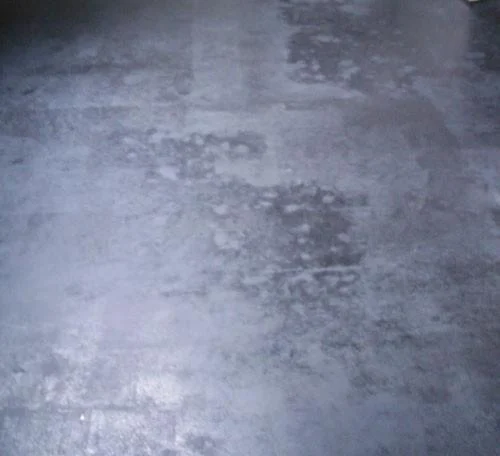
A cloudy pattern is not the same as a stain
A spilled liquid, a locally worn treatment, and a colour nuance in the concrete do not necessarily require the same approach. Therefore, look at the development: was the spot there from the execution, did it only become visible later, or did it arise after a certain event?
Gloss can also alter the perception of colour. A light strip near the window may appear different from another viewing angle. Therefore, alongside a detail photo, take an overview photo of the space. Indicate whether the floor is dry, has just been cleaned, or was recently treated. This helps us better interpret the images.
What information helps with the assessment?
- The execution: when was the floor poured and were there different pouring phases?
- The finish: which colour, wear layer, concrete curing or protection was agreed upon?
- The progression: have the differences changed since execution?
- The maintenance: which cleaning agents and treatments have been used afterwards?
- The images: an overview of the space and some detail photos, preferably under comparable lighting conditions.
A comparison with a photo on a screen has limitations. Lighting, shooting angle, and screen settings change the impression. An assessment on site may therefore be necessary before we propose a treatment.
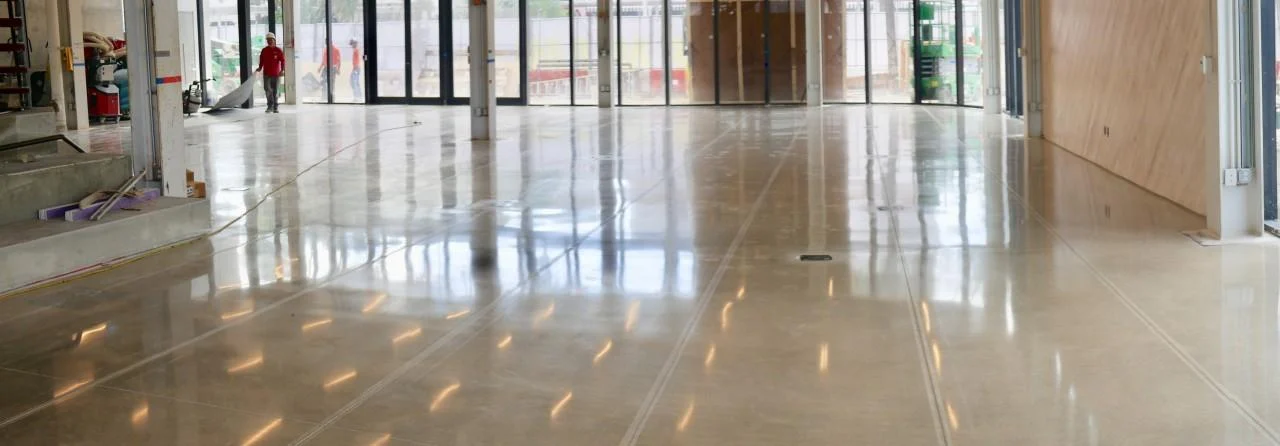
Can you sand away colour differences?
Sometimes a mechanical treatment is an option, but sanding is not a universal solution for colour differences. It removes material and can change the pattern, visibility of aggregates, and gloss. A local intervention can therefore actually make a new transition visible.
We first discuss the desired result and the existing finish. A trial in an agreed location helps to assess the possibilities. We do not promise a fixed number of sanding passes or a completely uniform final colour based on a photo. You can read more about this process at polishing an existing concrete floor afterwards.
Does impregnating or colouring afterwards help?
You choose a protective product based on the floor and its use. It is not an automatic colour correction. First, it must be clear which layer is present and whether a subsequent treatment is compatible with it. Read our explanation about impregnating, sealing and coatings.
Those who consciously want a different appearance can also explore the possibilities of colouring a concrete floor afterwards view. That is a choice for a different finish, which we discuss separately.
Limiting colour differences starts before execution
Discuss the desired appearance already when choosing the floor. Look at real references, coordinate colour and materials, and discuss where any pouring phases or transitions will occur. For a coloured broadcast layer, the Neodur colour chart a first direction; a small colour sample does not show all the nuances of a large floor.
Even after installation, agreements on protection and maintenance remain important. Keep the product names and follow the maintenance advice associated with your treatment. On polishing concrete floor you will find more practical explanation.
Want to have a colour difference examined?
Provide us with overview photos, the execution date, and information about the finish and maintenance. With that, we can more specifically discuss what a meaningful next step is.
Discuss your concrete floor
Colour differences in a concrete floor: causes and assessment