Craftsmanship in concrete
Where the machine stops, our hands continue working.
A long, narrow side of a concrete bridge pylon, lying on the pre-assembly site. For Stadsbader Contractors, Glansbeton finished this surface by hand. A special example of polishing concrete in places where we cannot work with a power trowel.
We polished the screeded side of the mast for the cable-stayed bridge over the E40, within the F29L project, commissioned by Stadsbader Contractors. The client chose manual finishing after the trial.
Meter by meter, we finish the fresh concrete. The surface, edges, and joints each receive the attention they need. The machine can watch here for a while.
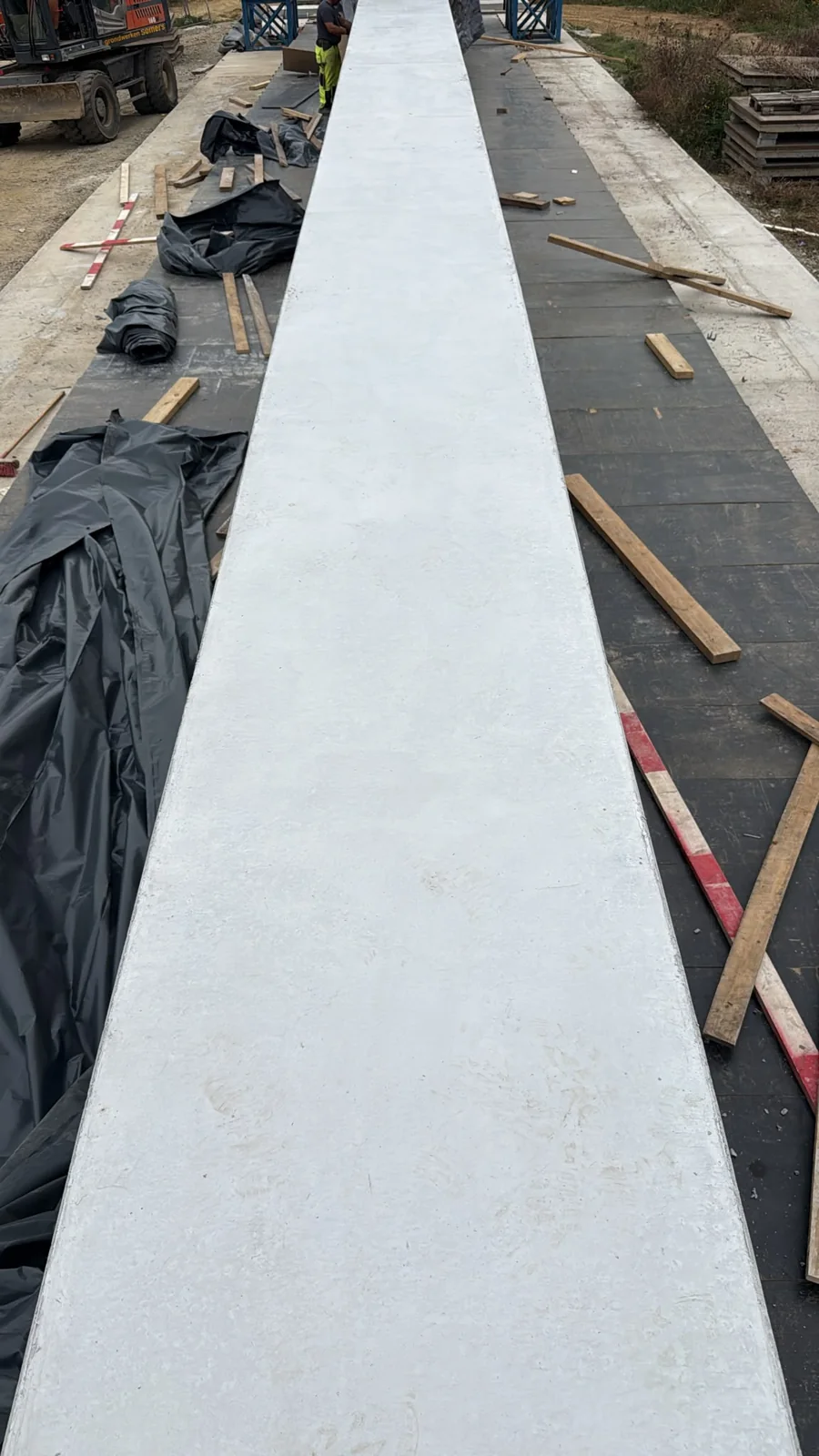
Manual fair-faced concrete finishing for a bridge pylon
This project concerned the screeded side of a mast for the cable-stayed bridge over the E40. The pylon was located on a pre-assembly site. Because of this, the photos show a long, narrow strip of concrete, but the finished surface is part of a bridge construction.
A preliminary test.
In the preparation, a test area of approximately 4 m² was provided, followed by about 30 m² of finishing on the mast itself.
Deliberately by hand
After the test, the client chose manual finishing. Glansbeton scheduled two employees for this.
September 2026
The final work arrangements scheduled the finishing of the mast on Monday 28 September 2026.
The formwork also required coordination: at the top there were rods to hold the form in place. During preparation, it was agreed to loosen and re-tighten these one by one to enable the finishing. Accessibility and work sequence were therefore concrete points of attention.
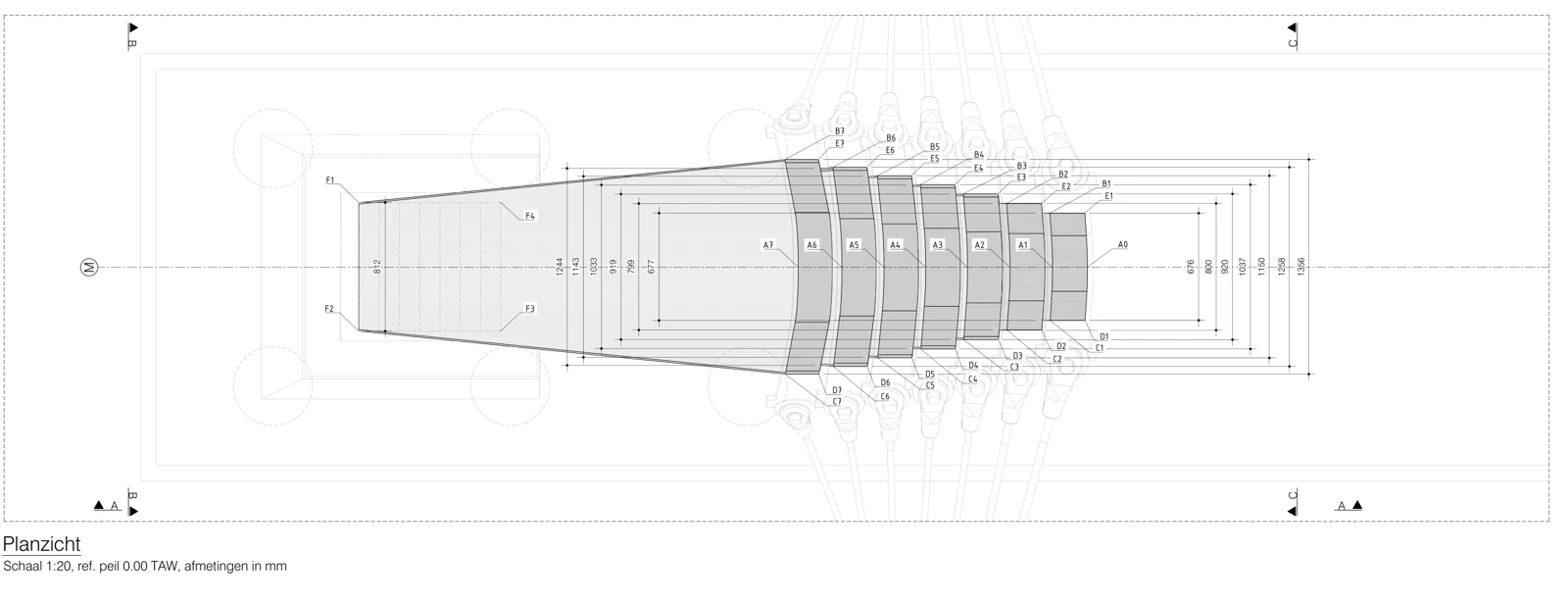
C50/60 self-compacting concrete: finishing at the right moment
For this project, Stadsbader specified C50/60 self-compacting concrete (SCC). The supplied concrete data sheet indicates an effective cement content of 455 kg/m³. These are the specific mix details on which the preparation was based.
The designation C50/60 refers to the strength class of the concrete. It is not a measure of the weight per cubic metre. Therefore, we describe this mix as C50/60 self-compacting concrete, without technically classifying it as ‘heavy concrete’.
During the trial surface it appeared that the concrete needed longer to set than expected beforehand. This underlines why the finishing cannot be scheduled solely at a predetermined time. Our people monitor the condition of the concrete and adjust the finishing moment accordingly.
The formwork plan requires smooth finished fair-faced concrete, with assessment of surface quality based on a trial. The trial, the choice for manual work, and coordination with the contractor were therefore essential parts of this execution.
Why polish concrete by hand?
For large, easily accessible concrete floors, we use power-trowelling machines. These require working space to be able to treat the surface. Narrow concrete strips, corners, joints and areas around obstacles do not always allow this.
We use hand tools for that. Sometimes it concerns a limited area at the edge of a larger floor. For a long, narrow strip, the entire finishing may require manual work. The available space and accessibility partly determine how we approach the work.
Narrow strips
Where there is insufficient width to work with a power-trowel, we finish the concrete manually in a targeted manner.
Edges and corners
The ends and sides are also part of the visible result. They deserve the same care as the centre.
Difficult joints.
Around obstacles and in hard-to-reach places, we adapt our working method to the available space.
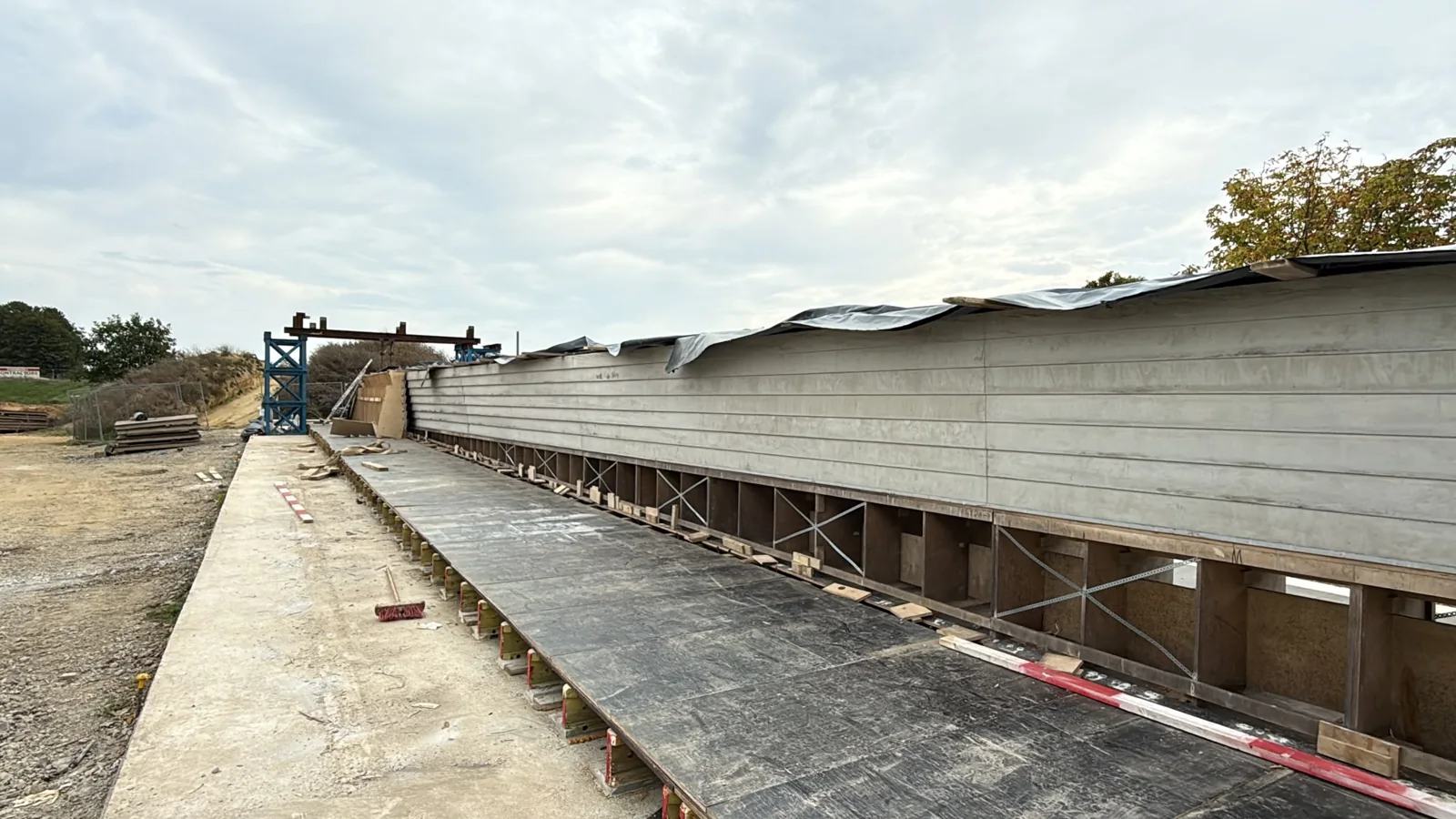
A long, narrow side requires attention over the entire length.
A small number of square metres does not automatically mean little work. With a long concrete strip, the edge finishing continues over a great distance. There is little width to work in, while the surface must be cared for over the entire length.
We pay attention to the whole and to the details. Anyone looking along such a strip naturally follows the length and both edges. The finish must therefore also form a neat whole from a distance.
Little space for a machine. All space for craftsmanship.
How do we finish the fresh concrete by hand?
Manual polishing is a treatment of the fresh concrete during execution. We finish the surface using suitable hand tools. This is not about grinding and polishing an existing, hardened concrete floor afterwards.
The right timing plays an important role. Concrete changes during curing: we adjust our treatment to the condition of the surface. Experience helps to judge when and how to proceed.
The movement and pressure must also suit the concrete and the desired finish. A long strip requires a consistent approach. We proceed step by step and continue to pay attention to the connection between successive sections.
The work does not stop at a beautiful surface. Further curing and protection of the young concrete are also part of careful execution.
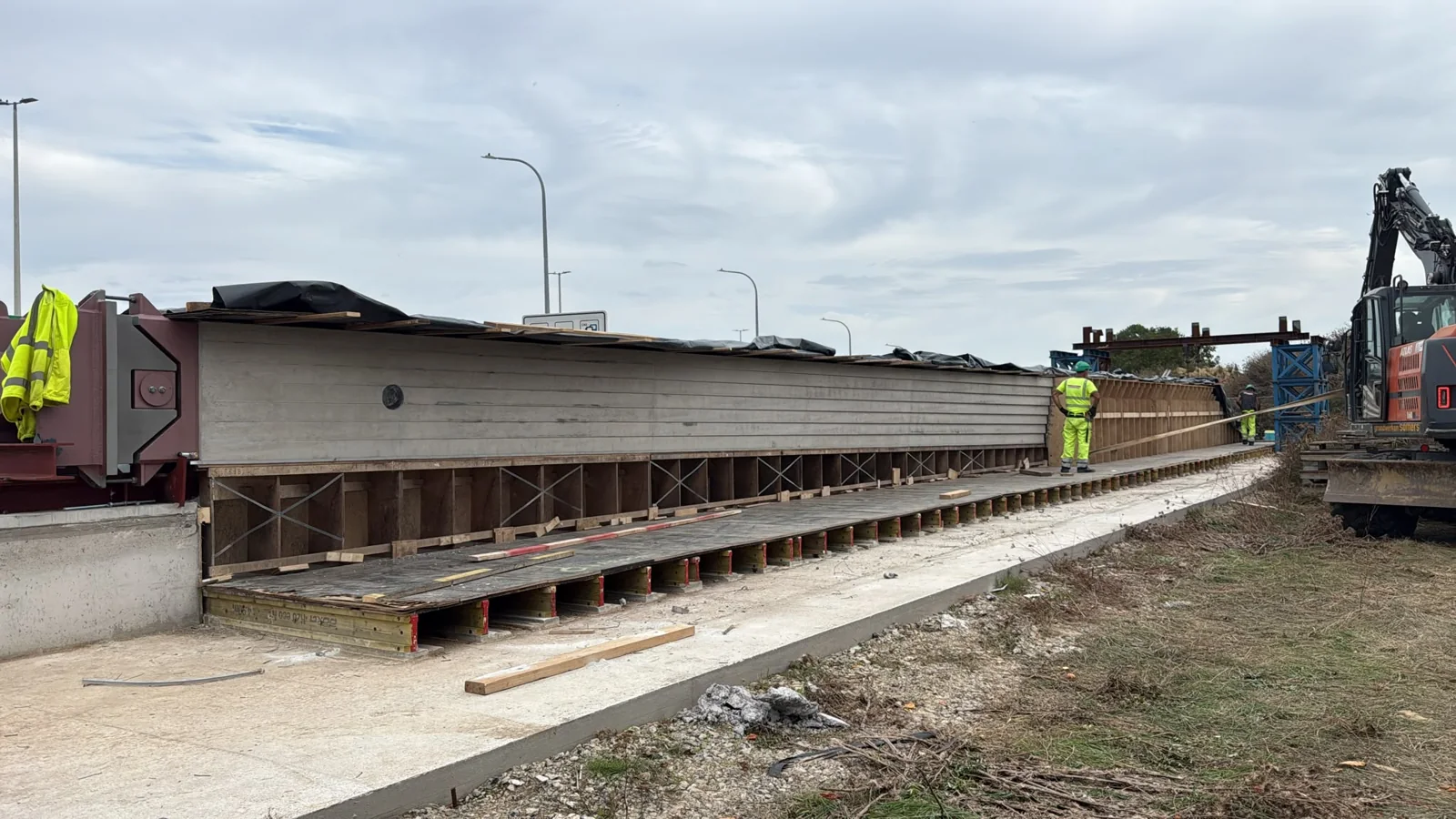
Custom trowels for precise edge work
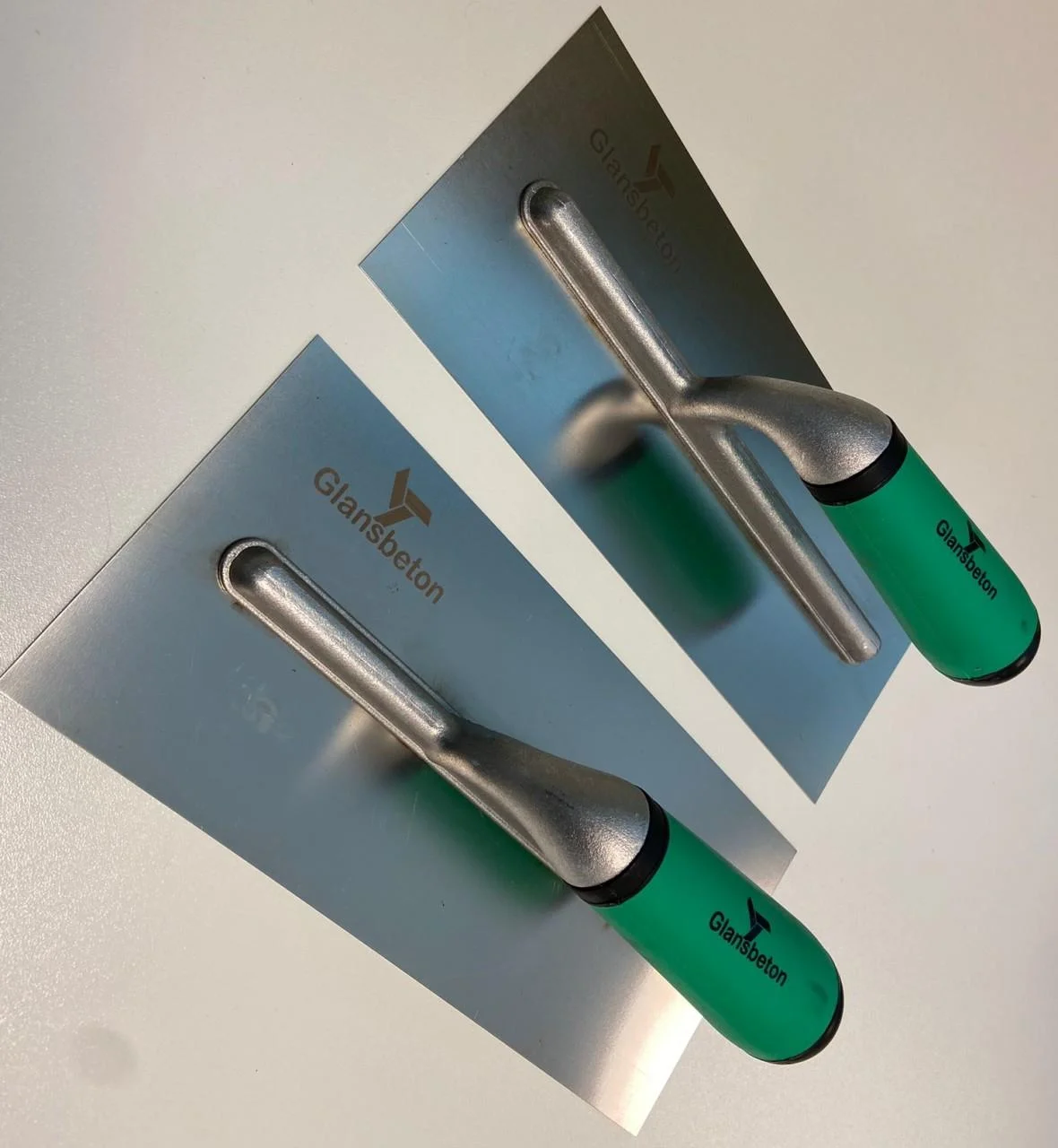
Glansbeton had custom trowels made for the manual edge work, with a thicker and sturdier design. The tool must work comfortably and controllably along edges and joints. The trowel alone does not determine the result: the experience of the worker and the condition of the fresh concrete are also important.
The finishing is done in successive operations. Between these operations, the concrete is given time to stiffen. We adjust the pressure, movement, and angle of the trowel to the surface. A fixed number of minutes or operations is not a reliable method for every concrete composition and every temperature.
When do we use an edging machine?
Where there is enough space, a smaller edging machine can work close along a floor edge. In tight corners or around obstacles, manual work remains necessary. Both techniques can produce a different surface appearance; a manually finished edge does not need to have exactly the same gloss or pattern as the machine-finished centre. Therefore, we consider the transition between both zones as part of the overall result.
Manual and machine polishing complement each other
Within a single project, both techniques can be used side by side. We use the machine where it can work well and take over by hand where the space requires it.
Manual finishing requires time and attention. The choice therefore depends on the shape of the surface, access, and the desired finish. Want to know more about the possibilities? Also see our explanation about polished concrete floors.
The finishing must suit the intended use
For exterior concrete, we consider not only the appearance. Grip in wet weather and rainwater drainage also matter. We discuss in advance which finish is suitable. Another option for outdoor installations is exposed aggregate concrete, with a visible grain structure.
Frequently asked questions about manual concrete polishing
When can a concrete floor not be polished with a machine?
For example, when a strip is too narrow, access is limited, or obstacles restrict movement space. We assess the situation per project; there is no fixed minimum width that applies to every site and every machine.
Can only part of a floor be finished by hand?
Yes. Manual finishing can also be necessary along edges, in corners, or around obstacles of a floor that is otherwise polished by machine.
What does hand polishing concrete cost?
That depends, among other things, on the surface area, the length of the edges, accessibility, and execution. A price per square metre alone does not tell the full story for a narrow strip. With photos, dimensions, and information about the use, we can assess the work more accurately.
Is this the same as polishing an existing concrete floor?
No. This article concerns the manual finishing of fresh concrete. Grinding or polishing an existing, hardened floor is a different process and requires a separate assessment.
A narrow strip or a difficult-to-reach concrete floor?
Send us some photos, the dimensions and a brief explanation of the intended use. Then we will consider how we can execute the concrete and which finish suits your project.
Discuss your concrete project
Hand-polishing concrete: where the machine cannot reach