Understanding concrete · strength and execution
The compressive strength of concrete indicates how much pressure the material can withstand. You recognise it on a concrete order by a class such as C25/30 or C30/37. But what do those two numbers mean, and what do they say and not say about your concrete floor?
What does C30/37 mean?
In C30/37, 30 stands for the characteristic cylinder compressive strength and 37 for the characteristic cube compressive strength, expressed in MPa. It concerns the same concrete class, assessed with two different types of specimens. The numbers are therefore not a minimum and maximum between which any arbitrary measurement must fall.
C30/37 at a glance
30 / 37
30 MPa on a cylinder · 37 MPa on a cube
The shape of the test specimen affects the measurement result. That is why the class specifies both values.
“Characteristic” is a statistical concept. The class is not simply determined by a single compressive test. It describes the strength level associated with a controlled assessment of a series of results. An individual result must therefore be interpreted within the applicable assessment rules.
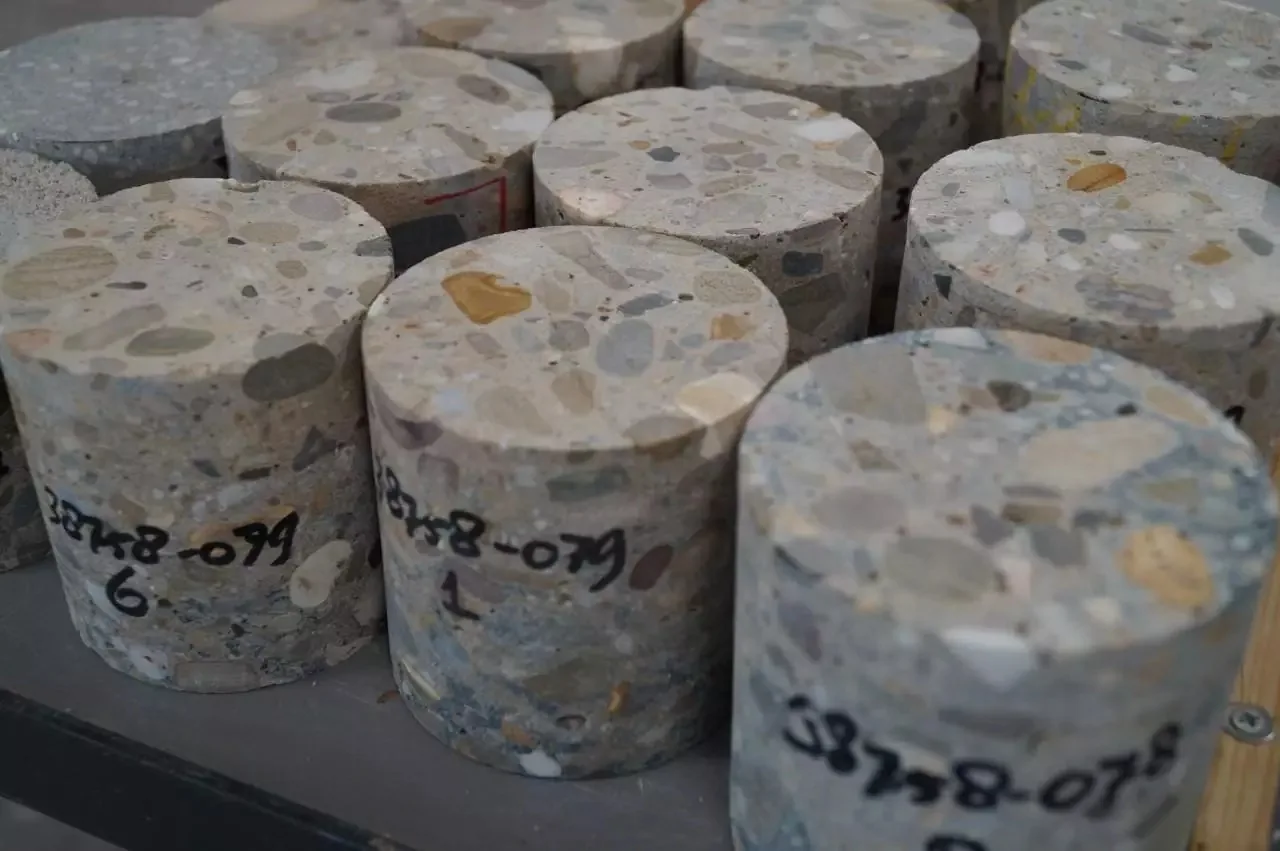
Overview of some concrete compressive strength classes
The table below helps to interpret common designations. It is not a requirement to automatically choose one of these classes for every floor.
| Class | Cylinder MPa | Cube MPa |
|---|---|---|
| C25/30 | 25 | 30 |
| C30/37 | 30 | 37 |
| C35/45 | 35 | 45 |
| C40/50 | 40 | 50 |
| C45/55 | 45 | 55 |
| C50/60 | 50 | 60 |
How is compressive strength measured?
Test specimens are made from the concrete and cured under prescribed conditions. Well-known reference formats are a cylinder with a diameter of 150 mm and a height of 300 mm, and a cube with sides of 150 mm. In a compression testing machine, the load is increased until the specimen fails. The force at failure, divided by the loaded surface area, gives the measured compressive strength.
For comparing results, not only the concrete mix but also the shape, dimensions, curing, age and testing method are important. A core drilled from an existing floor cannot therefore be equated to a standard test specimen from the concrete plant without further assessment.
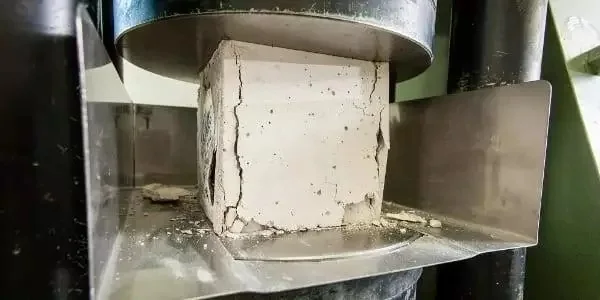
Why measure after 28 days?
Concrete gains strength through the reaction between cement and water. This strength development continues after pouring. The usual reference age for the strength class is 28 days; for specific projects, a different assessment age can be agreed upon.
That does not mean that every concrete is suddenly ready on day 28, or that it may never be loaded before then. The development depends, among other things, on the composition and temperature. A cold period can delay early strength development. The correct timing for loading, formwork removal or further finishing follows from the site conditions and the design.
What compressive strength do you need for a concrete floor?
That question starts with the use. Will the floor be in a house, a garage, a warehouse or an outdoor pavement? Is it a floor on solid ground or a load-bearing structure? What point loads, wheels or machines will be on it? Without that information, a strength class alone says too little.
The substrate, floor thickness, reinforcement, joint layout and connections also determine the behaviour of the floor. A higher concrete class does not compensate for a poorly compacted foundation or insufficient dimensioning. Therefore, have the required construction and strength class specified by the responsible designer where a calculation is necessary.
In the ordering concrete other properties also count, such as exposure to the environment, workability and grain size. Simply ordering “strong concrete” is not a complete description. For a polished concrete floor the mix must also be suitable for the intended processing and finishing.
What influences the ultimate strength?
Concrete composition and water
The mix must be balanced. The ratio between water and cement, the raw materials used and any additives influence the properties. Simply adding water to make the concrete easier to work with can change the designed mix. Coordinate changes with the concrete supplier and the person responsible for execution.
Placement and compaction
Concrete must be properly distributed and processed. The correct procedure depends on the mix: traditional concrete and self-compacting concrete do not necessarily require the same treatment. Hard-to-reach areas require extra attention to ensure that the chosen material performance is also realised in the execution.
Protection during curing
Young concrete that dries out too quickly can develop surface problems. Wind, sun and temperature partly determine what protection is needed. Therefore, it is appropriate to post-treatment with concrete curing with a carefully executed floor. Concrete curing is not a decorative final layer, but a step during the early hardening.
Practical example: C50/60 at a bridge pylon
For the project with Stadsbader, it concerned a very different concrete than an average residential floor: the project information specified C50/60 self-compacting concrete. Read how we achieved the accessible top surface hand polishing where the machine cannot reach.
Compressive strength, tensile strength and surface hardness are different
Concrete can withstand a lot of compression but is less strong in tension. Therefore, reinforcement and a well-thought-out structural design play an important role. The ratio between tensile and compressive strength is not a universally fixed percentage for every mix and situation.
The hardness or wear resistance of the floor surface is a different property. A concrete hardener for the top layer is not a way to simply upgrade an existing floor to a higher structural concrete class afterwards. The distinction helps to choose the right treatment for the problem you want to solve.
Frequently asked questions
Is C30/37 stronger than C25/30?
Yes, the specified characteristic compressive strengths are higher. That does not automatically mean that every floor with C30/37 can bear more load: the entire construction and subsoil remain decisive.
Is concrete fully cured after 28 days?
28 days is generally the reference age for the strength class. Strength development can continue thereafter. The time of commissioning must suit the load and the actual conditions.
Can I tell how strong concrete is by its appearance?
No. Colour, gloss or a dry-looking surface do not provide a reliable indication of compressive strength. For that, the specification, quality data and, if necessary, appropriate testing are required.
Technical background on the class designations and test specimens: Buildwise — assistance with concrete specification. The current regulations and the specific design apply to a project.
Concrete compressive strength: classes and C30/37 explained